From using AI to delivering AI: FDE workshop held in Shanghai
On 25 July 2026, Moments founder Liu Kai led an FDE workshop in Shanghai on taking AI projects from demo to delivery: ownership, evidence, risk and handover.
On the morning of 25 July 2026, the YiTang.top Shanghai Learning Center hosted an in-person public course, “FDE in Practice: From Using AI to Delivering AI,” in Shanghai. Moments founder Liu Kai taught the session, and a group of more than ten participants worked through how an AI project moves from a demo to a real delivery.
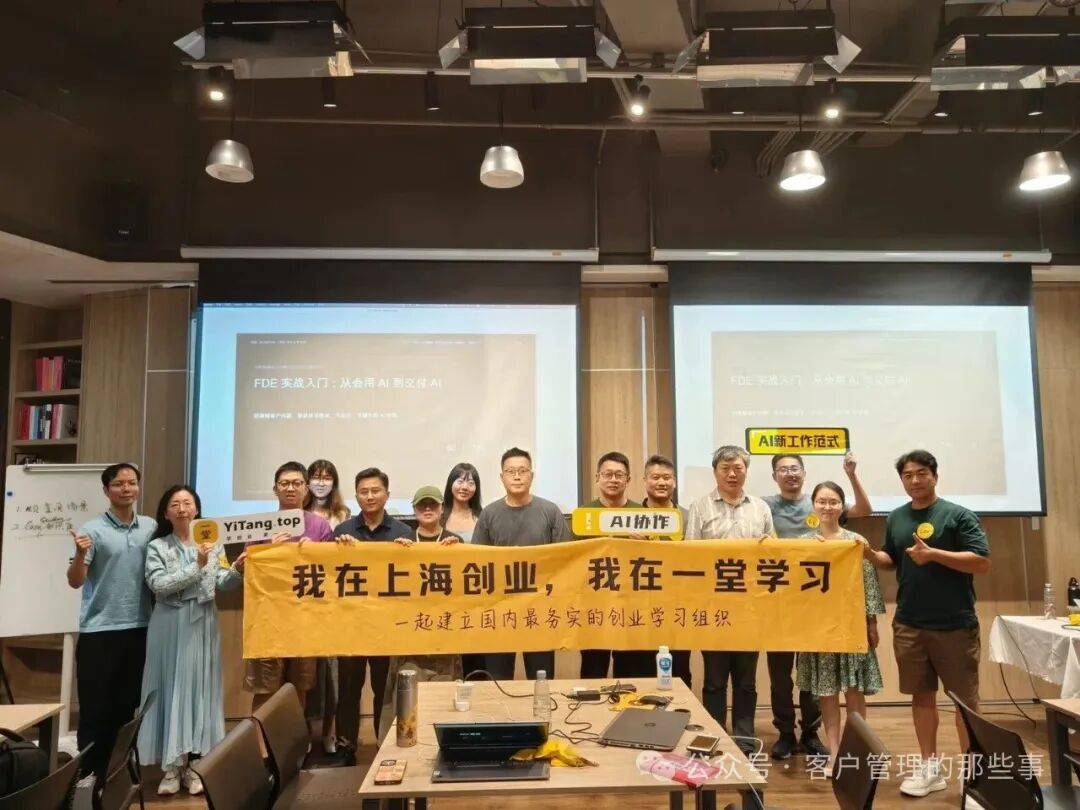
From something that demos to something that can be accepted, run and handed over
The course opened with one question: a demo already runs — if you are now responsible for the client’s outcome, what is still missing?
Beyond a single successful output, a team needs to define data boundaries, failure and stop conditions, run-time controls and launch risk, and confirm whether a new owner could reproduce the work independently.
FDE (Forward Deployed Engineer) is both a role — someone working close to the client’s operation and pushing results into production — and a way of working that keeps ownership across the lines between business, product, engineering and delivery. The course stressed that responsibility for the outcome should not break at a handoff: after the requirements and features are done, someone still has to decide whether it can go live, confirm the risks and make sure the client can take it over.
Let evidence decide whether each step continues
The course organized delivery around one framework: 1 Owner × 6 Gates × an evidence chain × a 4-part handover.
- One outcome owner: stays responsible for the business result throughout.
- Six gates: discovery, scoping, validation, delivery, launch and enablement. At each one, evidence decides whether to continue, roll back or gather more validation.
- A reviewable evidence chain: records versions, paths, criteria, failures, conditions under which a result stops holding, and who signed off.
- Four handover items: the production system, evaluation tests (evals), a runbook, and people inside the client who can drive adoption and take ownership.
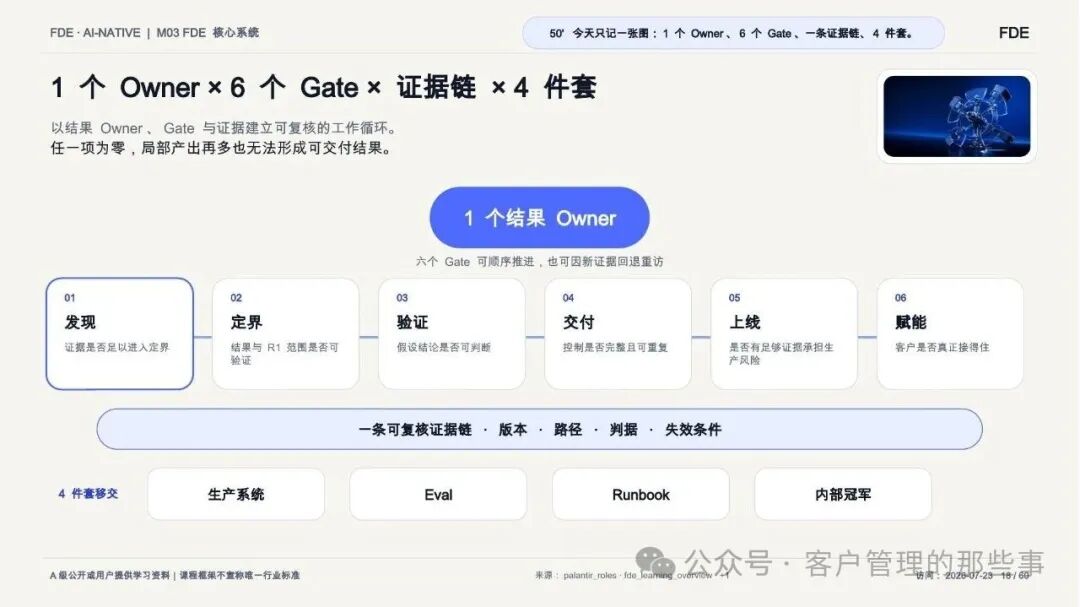
At every gate the team makes an explicit call: GO, NO-GO or MORE-EVIDENCE. Validation exists so that assumptions can be tested, not just so that one demo goes smoothly.
AI executes, people keep the key decisions
In the AI-native Rescue Lab segment, the course used ServiceOps, a synthetic teaching case. Starting from a fixed baseline and an eval suite, participants wrote a Task Contract stating the verified facts, the assumptions still to be tested, the goal for this round, which files may be changed, prohibited actions, acceptance criteria and the decisions that must be made by a person.
The agent reads the project, produces scoped changes and summarizes the evidence; the person narrows the scope, reviews the changes, judges the risk and confirms whether to move to the next step. This teaching case was used to practice the delivery method and is not presented as a client result.
Start with one real scenario
To close, participants went back to their own jobs: each chose one user, one process and one result that does not yet exist, wrote down the goal, baseline, non-goals and owner, drafted a first Task Contract, and set the next piece of evidence and a check-in date.
Going from using AI to delivering AI takes more than tool fluency. It takes sustained responsibility for business outcomes, operational risk and client handover.
If your team is running an AI project and wants to talk through specific acceptance, launch or handover problems, talk to Moments.
Related
- AI agent — An AI agent is a program that plans its own steps, calls tools and adjusts based on results to reach a goal, rather than just generating a block of text.
- Baseline and retest — A baseline retest measures AI answers with a fixed question set before optimizing, then repeats the exact same method later and compares the difference.