Momo decision partner update: clarify the question first, then research for the business
Momodi updated Momo, its decision partner for product, export and competitor calls: it clarifies product, market and constraints first, then cites sources.
Product promotional visual | Check before you decide. (AI-assisted artwork)

When you plan to sell a product overseas, the first things you find are usually “market size,” “hot categories” and “growth trends.” The material piles up, but the decision you actually have to make is still unanswered: who buys the first shipment? Which channel goes first? Under what conditions should you hold off on ordering stock?
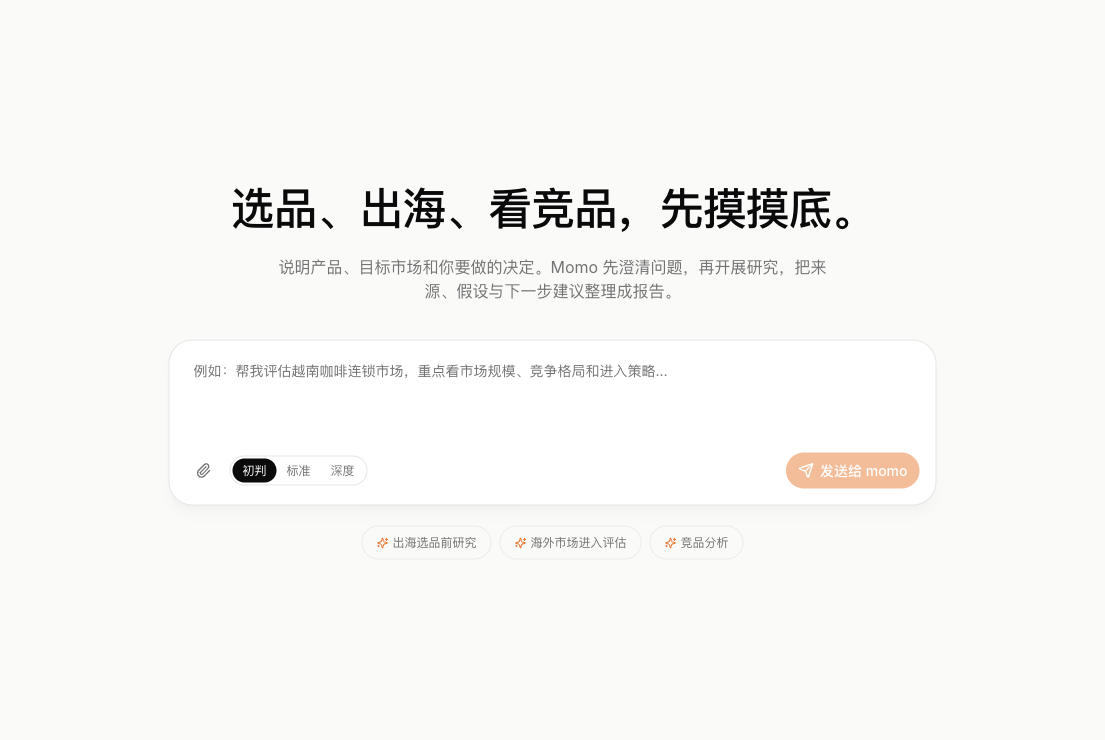
In October 2026, Momodi updated Momo, its decision partner. Users can start by describing their product, target market and the decision they need to make; Momo clarifies the question, then runs the research and organizes sources, assumptions and recommended next steps into a report. The web entry point is now open, with three options: Quick take, Standard and Deep.
The update is meant to solve one specific problem: before you spend time and credits on research, work out what answer you actually need.
Figure 1 | Momo’s current web entry point: describe your product, target market and the decision to be made. The screenshot shows only public product areas.
Research helps only once you say what you are deciding
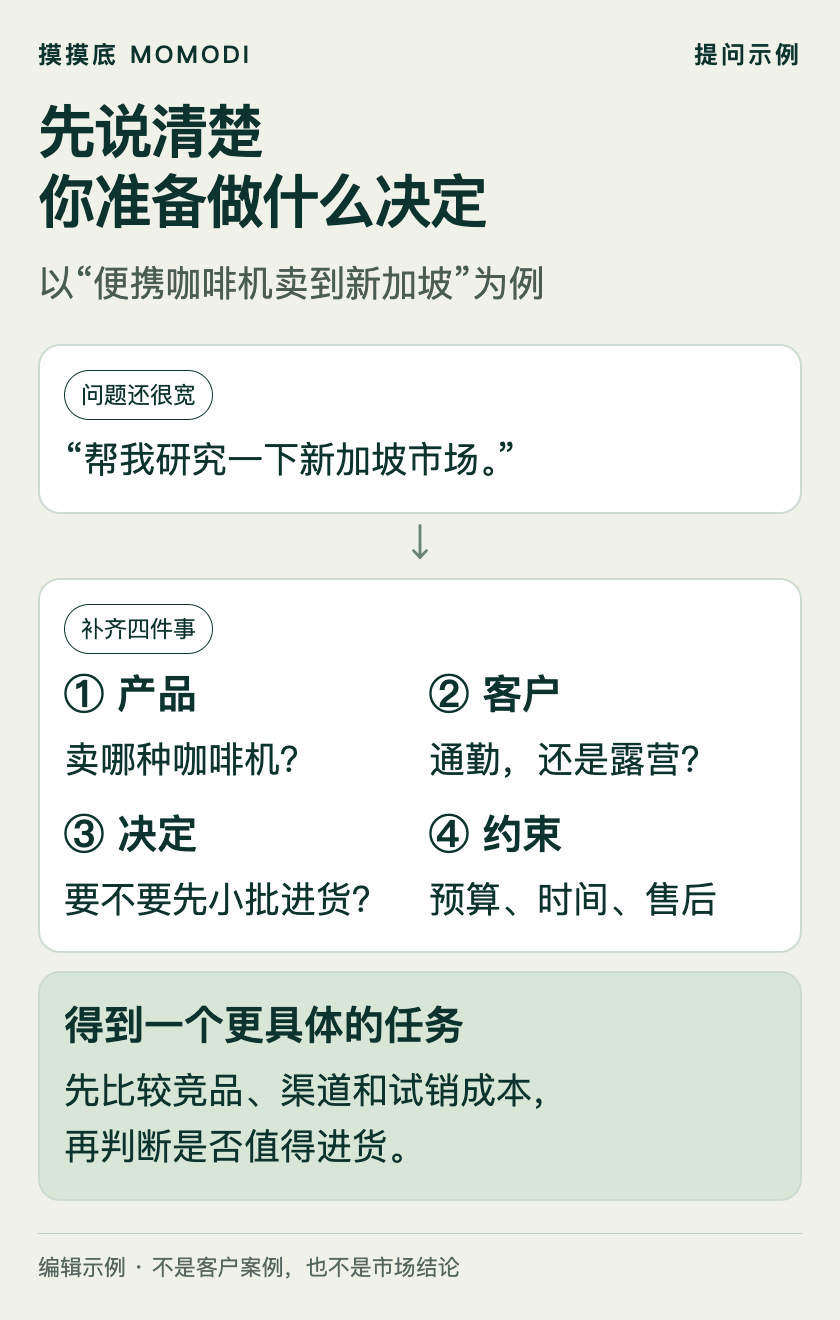
“Research the Singapore market for me” returns plenty of material but rarely helps you decide whether to order stock.
Phrase it differently and the direction becomes clear:
I plan to sell portable coffee machines in Singapore and want to start with a small trial in one channel. I haven’t settled pricing or the target customer yet. First help me work out: what product information I still need to provide, which competitors to compare first, and which costs I must verify before deciding whether to order stock.
This is an example task, not a client business result. On 19 October 2026, we submitted this scenario to Momo through the momodi CLI’s anonymous trial chat, asking it to clarify first without starting formal research. The reply asked about the product form, whether it was an own brand or a distributed one, the target customer and the size of the trial, and suggested that competitors, channels and costs could be investigated next.
This trial only shows that it can offer clarifying suggestions around that question. It does not show that any market conclusion is correct, and it does not mean formal research was completed. Details in the reply such as market judgments and tax rates came with no verifiable sources in this trial chat, so they cannot be used directly for pricing or purchasing decisions.
For the user, the value of clarification is concrete: first separate whether “selling to campers” and “selling to office workers” are the same question, then decide which prices, reviews and sales channels to look into. A narrower research task produces material that is easier to compare.
From trial chat to formal research, invest according to the question
Figure 2 | Narrowing a broad question into a researchable task. This is an example prompt, not a client case.
The Momo web page offers Quick take, Standard and Deep. If you have not yet clarified your goal, use Quick take to sort out direction; when you need a formal report, choose Standard or Deep according to the task and your account entitlements. Quick take is not a complete research report, and choosing Deep does not mean every question will get a definite answer.
At present, users who have not registered can try 3 rounds of chat to clarify the question and research direction. After logging in, users can upload material, save research and run formal research; specific permissions and credits are as shown in the account after login. Users with an existing membership or an offline activation record should check their existing entitlements before buying another plan.
Uploaded material should serve real work too: if you already have product specifications, a price list or research notes, add the material you are permitted to share with the platform to the task so the research is built around your own product. Don’t give it just a category name and expect the report to know your costs, supply capacity and after-sales terms.
Sources are there so you can check, and push back
The data scope Momo currently describes publicly includes overseas social content, e-commerce, app stores, financial reports, US customs bills of lading, as well as Xiaohongshu (RED, a Chinese lifestyle platform) and company registry information. Different sources answer different questions: consumer reviews can point to pain points, product pages can be used to compare list prices, and financial reports are suited to checking what a company has disclosed about its business.
But all of these have limits. A few negative reviews do not represent a whole market; a list price is not a transaction price; and one source link does not mean a conclusion is well established. Whether the platform has usable data also depends on the specific region, time, access rights and task.
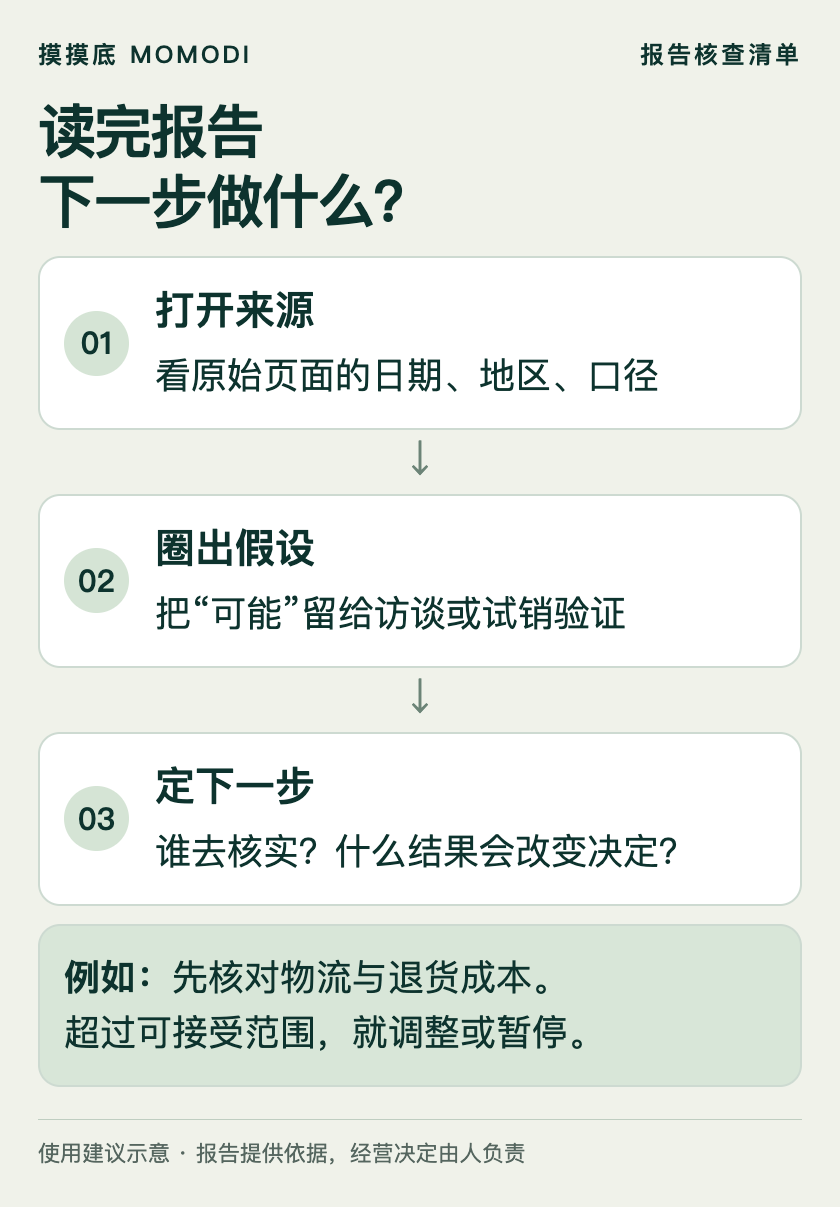
When you receive a report, check three things first:
- Where does this number come from? Open the original page and check whether the date, region and scope fit your question.
- Which sentences are still assumptions? For example, “office workers may need portable coffee machines more” should be tested further through interviews, trials or small-scale sales.
- What is the next step, and what result would change your decision? For example, verify logistics and return costs first; if they exceed what you can accept, change channels or pause ordering.
That is what using research in a business means: not just reading a report, but knowing which evidence supports the current judgment, which information is still missing and who should verify it next.
Figure 3 | Checking order after receiving a report: open the sources, mark the assumptions, set the next step.
For long-term use, agree the service scope first
For teams that want to build up business context over time, the Momo product page also offers demo consultations for business memory, dedicated skills and data sources, private deployment and integration with common chat tools.
These are value-added services that require a scoped proposal; they should not be read as enabled by default for every standard account. A company can come with one specific question: where its existing material lives, who can see it, which model is used, where the information flows and who reviews the final output. The deployment and service scope actually confirmed is what applies.
Sources marked “integrating” or “coming soon” on the product page should not be treated as available capabilities either. X.com is marked as integrating; China’s National Bureau of Statistics, industry associations and macro import/export data from the General Administration of Customs are marked as coming soon.
The first time, bring these four sentences
Open Momo decision partner; you don’t need to write a professional research brief first. Just complete these four sentences:
The product I sell / service I provide is…
The customers and region I plan to target are…
The decision I have to make now is…
My budget, timeline, existing material and unacceptable risks are…
Where you’re not sure yet, you can simply say “I don’t know” and let Momo find what information needs to be added. You can also first browse the Discovery public report library to see the report format, then decide whether it suits your task.
Our view: the value of AI research lies first in helping people state the question clearly, lay out the evidence and set the next step. Whether to order stock, enter a market or commit capital remains the responsibility of the people who know the real business conditions.
This post is based on product pages as of 19 October 2026 and one anonymous clarification trial. We did not test full paid research, private deployment or all data sources, and we make no promises about research time, business returns or decision success rates. For the version issue found in the anonymous CLI trial, see the separate update.
Related
- momodi CLI released: start research and retrieve reports from your terminal and AI assistant — Momodi released the momodi CLI and MCP server (npm 0.1.1) to start research, track progress and fetch HTML reports from a terminal or AI assistant.
- How to write a market research report: template, evidence log and worked example — Build a market research report around the decision it supports, with a section template, evidence log and example wording, plus what AI research can and can't do.
- MoMoDi vs traditional market research: when you still need a research firm — Use AI research when conclusions can come from public information; hire a research firm when they must come from real people. Most projects need both.