From using AI to building an AI coworker: hands-on training for Pudong's high-skill talent program
On 29 August 2026, Liu Kai ran AI workplace training for the Pudong Technicians Association's high-skill class, built from 50 surveys and real job tasks.
On 29 August 2026, Liu Kai delivered the course “Applied AI and a Personal AI for Better Work” to the high-skill talent training class of the Pudong Technicians Association, held at the Shanghai high-speed rail locomotive depot. The session started from one concrete question: for people who already use AI to write text, how do you get it to take on a real, repetitive piece of work?

Finding the real need in the pre-course survey
Fifty pre-course surveys showed that 76% of respondents use AI at least once a week and 90% said they had already mastered AI-assisted writing. But when asked about learning goals, 82% wanted to learn “scenario-based use of AI tools and building a dedicated AI coworker,” and 66% wanted to solve specific technical or management problems at work.
These are multiple-choice percentages, so they cannot be added together, and they represent only the 50 surveys returned for this session. They gave the course design a direction: participants did not need more tools so much as the ability to brief a real task clearly and have AI work to stable rules.
Turning one small task into a reusable tool
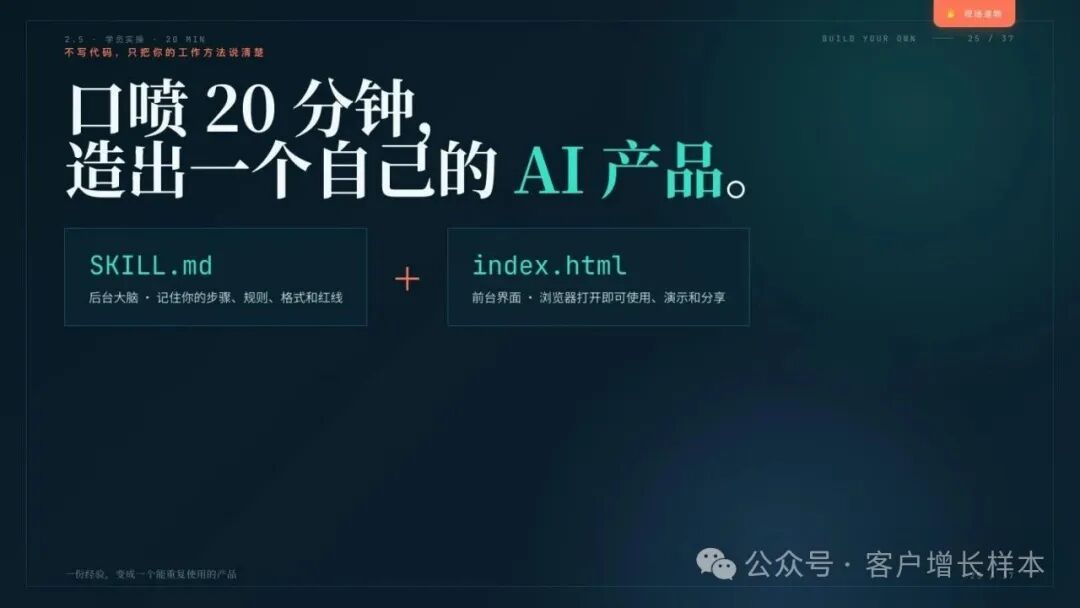
The 90-minute session was designed around four exercises: understand what has changed, learn to brief work clearly, set up an AI coworker, and build a small AI product. The course plan does not mean every participant finished every goal on site; the practice ran in these steps:
- Pick one real, repetitive small task. For example, turning meeting notes into a weekly report, where the result can be checked for complete owners, deadlines and action items.
- Use a “four-box brief” to state role, goal, constraints and examples. This turns a verbal request into instructions that can be executed and checked.
- Lock the repeated rules into a Skill. With a new batch of material, you no longer have to explain the steps and deliverables from scratch.
- Build an interface as a single HTML file. An input box and buttons make it easier for coworkers to use the same process.
- Test three kinds of input: normal, missing information and out-of-bounds. Check whether it completes the task, whether it asks follow-up questions, and whether it holds the line on sensitive data or requests involving payment, signing contracts, deleting data or publishing externally.
Taking the exercise back to the job
The participant handbook narrowed the follow-up to a 7-day task: choose one piece of work, run it for real 3 times, then revise 1 rule based on what went wrong. A good starter task repeats often, has relatively stable inputs and produces a result a person can check.
After the course, 56 ratings were collected: 49 fives, 6 fours and 1 three. The feedback summary records an average of 4.85, with 98.2% at 4 or above. Written comments mentioned the usefulness of scenarios such as merging multiple spreadsheets, classifying data, monthly charts and building a personal AI.
This feedback shows the course was well received; it does not mean job efficiency has improved. The real effect has to be checked in participants’ task run records: which repetitive work was reduced, which inputs still cause errors, and which steps must stay with a person.
If your team wants AI training that starts from real job tasks, talk to Moments about your needs and bring one piece of weekly, repetitive work you want to improve.
What to check when buying similar training
This record discloses the course date, location, the 90-minute teaching plan, the 50 pre-course surveys and how post-course feedback was measured. It shows how job needs fed into the course design and how the class organized task briefing, rules and input testing. It does not disclose enterprise pricing, and it provides no before-and-after comparison of participants’ efficiency back on the job.
When preparing in-house training, confirm separately the pre-training task collection, anonymization of materials, tool accounts, on-site coaching and the scope of post-course re-testing. Completing an exercise in class and reusing it independently back at work should be accepted separately. Use the enterprise AI training needs and budget checklist to list job tasks, then choose role-based AI training or in-house marketing team training.
Related
- AI agent — An AI agent is a program that plans its own steps, calls tools and adjusts based on results to reach a goal, rather than just generating a block of text.
- Corporate AI training: what to teach, what it costs, and a buying checklist — Pick corporate AI training by job task, then price it by headcount, hours, custom materials and follow-up support. Includes an intake checklist and acceptance tests.